Показаны сообщения с ярлыком нейромедиаторы. Показать все сообщения

16.08.2012

Очередные новости об избавлении от опиатной зависимости

Действительно интересно. оказывается, на подходе очередное средство борьбы с героиновой и морфиновой наркоманией. Более того, учёные утверждают, что с помощью новейших подходов можно не только избавиться от зависимости, но и не страдать от болезненных ощущений. Подробности:
Unlike the heroin-specific vaccine we covered last year, an international team of scientists from the University of Adelaide in Australia and the University of Colorado Boulder has now found a way to block addiction to various opioid drugs, including heroin and morphine. Importantly, the new approach doesn’t negatively affect the pain-relieving properties of these drugs.
The central nervous system and the immune system both play important roles in the development of an addiction, with opioid drugs such as heroin and morphine binding to an immune receptor known as Toll-like receptor 4 (TLR4) in a similar way to the normal immune response to bacteria. Dr. Mark Hutchinson, ARC Research Fellow in the University of Adelaide’s School of Medical Sciences says, “The problem is that TLR4 then acts as an amplifier for addiction.”
In studies on rats using (+)-naloxone, a drug that automatically shuts down the opioid addiction by altering brain chemistry to stop production of the feel-good chemical dopamine, the researchers found that blocking the immune response is all that is required to prevent cravings for opioid drugs.
“Our studies have shown conclusively that we can block addiction via the immune system of the brain, without targeting the brain’s wiring,” said Hutchinson, who was lead author of the study.
“This work fundamentally changes what we understand about opioids, reward and addiction,” adds senior author Professor Linda Watkins, from the Center for Neuroscience at CU-Boulder. “We’ve suspected for some years that TLR4 may be the key to blocking opioid addiction, but now we have the proof.
“The drug that we’ve used to block addiction, (+)-naloxone, is a non-opioid mirror-image drug that was created by Dr. Kenner Rice in the 1970s,” Watkins said. “We believe this will prove extremely useful as a co-formulated drug with morphine, so that patients who require relief for severe pain will not become addicted but still receive pain relief. This has the potential to lead to major advances in patient and palliative care.”
The researchers say clinical trials may be possible within the next 18 months.
The results of their study are being published in the August 15 edition of the Journal of Neuroscience.
Source: University of Adelaide
За инфу спасибо http://www.gizmag.com/opioid-addiction-immune-system/23706/ 

26.07.2012

Опять результаты исследований эффектов экстази

Ну, в общем, читайте: экстази и память, некоторые новые данные.

Though ecstasy is known to cause health risks such as depression, sleep problems, severe anxiety and increasing other drug cravings, there has been a considerable amount of debate questioning whether or not government officials have over-reacted to ecstasy.

16.07.2012

Как достать всех в лабе

Гениальная статья о том, как стать "звездой" в лабе. Цитирую:


We all know them. You might even be one. The Lab Bastard is the one who considers himself (or herself!) superior to all other mere mortals in the lab. He would never degrade his talent by doing communal jobs in the lab, but swans around, absolutely sure that his experiments are most important and his results will be the most groundbreaking.
Above all, The Lab Bastard never misses an opportunity to claw his way to the top and doesn’t mind who he tramples on along the way.
I hope you don’t want to be The Lab Bastard. But in case you do, here are some useful tips:
When starting in a new lab, establish your superior credentials:
1) Never miss an opportunity to say how thing were done much better in your previous lab/your country.
2) Do a bit of namedropping; it always helps to impress the poor no-hopers you work with.
3) Declare equipment, supplies and methods that your colleagues use as outdated and insufficient for your needs. Order a lot of new stuff immediately, or even better, tell a technician do it for you.
Ensure that your talents are not wasted on menial tasks. Put technicians and your other colleagues in their rightful place as servants who are lucky to have a bit part to play in your journey to brilliance:
4) Make a point of never ordering ANYTHING. Ensure that no matter how small the order is, you pass it off to someone else to do it for you.
5) Never do any lab jobs – defrosting the freezer, cleaning the water bath, etc. It distracts you from doing experiments and there is always a backup freezer/another water bath, when they break because of the lack of maintenance.
6) If you finish a communal solution, be happy that there was enough left for you. You either won’t need it for a while, or, if it is widely used, somebody else will have to make it very soon.
7) Feel free to take stuff from other people’s benches. They have plenty of it or are not using it at the moment and you are working so much, you don’t have time to prepare or order this in advance.
Help No-one
8) Never volunteer to help anybody and never share your things, this will diminish your resources in exchange for a hazy possibility that people will pay you back in kind. They never do, you know, because you don’t.
Claim your rightful credit
9) Always ensure that you talk loudest in lab meetings – if you can talk over others, then so much the better. When you are making your razor sharp observations, be sure to keep eye contact with the boss at all times to ensure that your brilliance is noted.
10) A caveat to number 8: There is a time to volunteer to help people, and that is when they are close to publishing. At this point, use all of your skills and influence to secure the opportunity to do a (preferably very small) piece of work for the prospective author, then push like hell to be added as a co-author.
Спасибо http://bitesizebio.com/articles/how-to-be-the-lab-bastard/ 
Самое смешное - что такие везде находятся :) 

09.06.2012

Анимашка - распространение депрессии


raneynickelcatalyst:

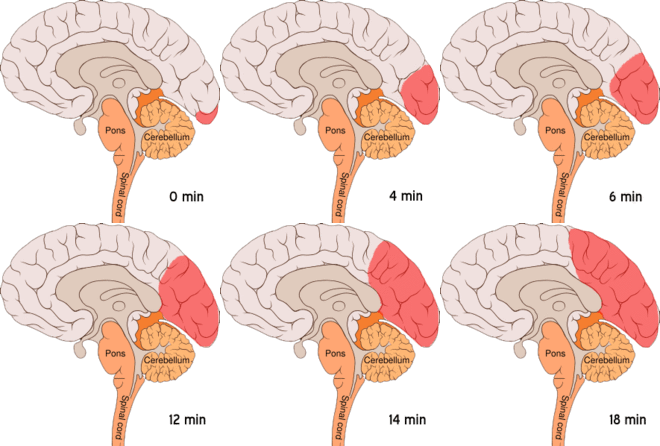
Animation of cortical spreading depression. Cortical spreading depression is a wave of electrophysiological hyperactivity followed by a wave of inhibition, usually in the visual cortex.Increased extracellular potassium ion concentration and excitatory glutamate contribute to the initiation and propagation of cortical spreading depression, which is the underlying cause of migraine aura.

source: wikipedia


14.02.2012

С Валентином, гики!

05.01.2012

Опиаты более страшны для людей с психическими проблемами

С праздничками, коллеги!
Вот вам свежая новость от капитана Очевидность.

Оказывается, люди с психическими расстройствами (биполярный психоз, депрессия и т.д.) более подвержены зависимости от опиатов. Полный текст на http://www.biologynews.net/archives/2011/12/13/opioid_abuse_linked_to_mood_and_anxiety_disorders_.html
Да вы что!1111111111111 Оо

24.12.2011

Эффекты разных психоактивных веществ на уровне синапсов

Простенько, но со вкусом.
http://faculty.plattsburgh.edu/donald.slish/DA.html

20.12.2011

Допамин в свежих научных новостях

Я очень люблю допамин. Да и как можно его не любить, если именно это чудесное вещество отвечает за нашу мотивацию, удовольствие и другие приятности? В этом блоге достаточно много постов посвящены этому нейромедиатору, поэтому сейчас я хочу поделиться ссылкой на свежайшую статью из авторитетного источника, в которой раскрываются какие-то интересные и не известные до этого, сведения о допамине.

Сообщение на http://www.eurekalert.org/pub_releases/2011-12/osum-ans120111.php гласит, что допамин может быть крайне полезен при лечении опухолей. Оказывается, этот катехоламин способен увеличить эффективность действия противораковых препаратов и радиотерапии! Допамин улучшает приток крови к опухолям и таким образом повышает концентрацию действующих веществ именно в месте потребности, так же увеличивается уровень насыщения этих участков кислородом, что так же способствует борьбе с опухолью. Такие результаты были получены на животных моделях рака груди и кишечника.

30.11.2011

1 из 5 американцев сидит на психоактивных лекарствах

Оптимистичненько так. Называется, сделай сам - настроение? - а зачем, ведь есть таблетки, которые создадут любое настроение.
Вот такой интересный материал на http://blisstree.com/feel/1-in-5-americans-on-mental-health-drugs-overmedicating-817/ советую вам почитать для размышлений:

Almost half of all Americans take at least one prescription drug, and now a new report tells us that more than 20% of us take at least one medication to treat a mental health problem–a number that is up 22% since 2001. It’s an alarming trend for sure, and has us wondering: Are all of these drugs really necessary, or are Americans over-medicated?
Granted, mental health disorders are a serious illness which require serious treatment. According to the statistics released by Medco Health Solutions, more than a quarter of us suffer from mental health problems which have us taking antidepressants, antipsychotics, attention deficit hyperactivity disorder drugs or anti‐anxiety treatments every year. And women are far more likely to take a drug to treat a mental health condition than men with those over 45 showing the highest use.
And yet, the World Health Organization says this doesn’t necessarily mean that we are over-medicated.
So what does it mean? Are more Americans just getting diagnosed with depression, anxiety or other mental health disorders? Are these conditions becoming more prevalent? Or, are doctors simply taking the easy way out and prescribing more drugs than necessary without exploring other alternate treatments first for less severe cases?
In Charles Barber’s Comfortably Numb: How Psychiatry Is Medicating a Nation, the New York Times stated that he makes a case for Americans being “vastly overmedicated for often relatively minor mental health concerns”. There is also the theory to the sharp rise in mental health medications: We are asking for them. TheNY Times also suggested that we are a self-drugging society in many respects. We are often too quick to pop pills when something doesn’t feel quite right. Many of us use alcohol to numb feelings of stress, anxiety and depression. It was even suggested that some Americans are taking mental health medications for “ficticious concerns”. For that, we can point a finger to all of the marketing and advertising that the drug companies are doing (over $5 billion a year) that suggest we may have a problem (even though we thought we were fine until we saw their commercial telling us how depressed we are).
In a recent Blisstree post, I talked about the fact that some doctors think depression could actually be good for usbecause it forces us to face our issues and dissect exactly what is happening in our lives and in our head. Because of this, some doctors still think that other mental health treatments like talk therapy should be explored first because putting a pharmaceutical bandage over our depression or anxiety can often preclude us from uncovering our source of true happiness. Other experts have also suggested that a healthy diet, stress-reduction and even yoga can help bring us back to a positive mental state.
Tell us what you think. Are Americans too quick to take mental health medications?

04.11.2011

Паразит мозг не съест, но химию его изменит...

Сто лет не обновляла этот бложик, пардон.
Вот вам забавная новость. На английском, ага, как обычно.
Некоторые паразиты (токсоплазма, например) в мозгу могут феерически изменять выработку допамина.

Brain parasite directly alters brain chemistry

A research group from the University of Leeds has shown that infection by the brain parasite Toxoplasma gondii, found in 10-20 per cent of the UK's population, directly affects the production of dopamine, a key chemical messenger in the brain.

Their findings are the first to demonstrate that a parasite found in the brain of mammals can affect dopamine levels.

Whilst the work has been carried out with rodents, lead investigator Dr Glenn McConkey of the University's Faculty of Biological Sciences, believes that the findings could ultimately shed new light on treating human neurological disorders that are dopamine-related such as schizophrenia, attention deficit hyperactivity disorder, and Parkinson's disease.

This research may explain how these parasites, remarkably, manipulate rodents' behaviour for their own advantage. Infected mice and rats lose their innate fear of cats, increasing the chances of being caught and eaten, which enables the parasite to return to its main host to complete its life cycle.

In this study, funded by the Stanley Medical Research Institute and Dunhill Medical Trust, the research team found that the parasite causes production and release of many times the normal amount of dopamine in infected brain cells.

Dopamine is a natural chemical which relays messages in the brain controlling aspects of movement, cognition and behaviour. It helps control the brain's reward and pleasure centres and regulates emotional responses such as fear. The presence of a certain kind of dopamine receptor is also associated with sensation-seeking, whereas dopamine deficiency in humans results in Parkinson's disease.

These findings build on earlier studies in which Dr McConkey's group found that the parasite actually encodes the enzyme for producing dopamine in its genome.

"Based on these analyses, it was clear that T. gondii can orchestrate a significant increase in dopamine production in neural cells," says Dr McConkey.

"Humans are accidental hosts to T. gondii and the parasite could end up anywhere in the brain, so human symptoms of toxoplasmosis infection may depend on where parasite ends up. This may explain the observed statistical link between incidences of schizophrenia and toxoplasmosis infection."

Dr McConkey says his next experiments will investigate how the parasite enzyme triggers dopamine production and how this may change behaviour.
http://www.eurekalert.org/pub_releases/2011-11/uol-bpd110411.php

08.07.2011

Прощай, Прозак, Привет, Микроб!

В сфере поиска новых эффективных антидепрессантов - революция. Вероятно, что состав микрофлоры кишечника может влиять на ментальное состояние достаточно сильно. Поэтому приём правильных пробиотиков, в определённом смысле, сможет снизить потре6ность в традиционных антидепрессантах.
Читаем подробнее статью  на http://blisstree.com/feel/goodbye-prozac-hello-microbial-bacteria/:

Probiotics are the good-for-you bacteria found in things such as yogurt and kombucha (plus in myriad dietary supplement forms) and alleged to help with digestion, immune-system functioning, stomach issues, diarrhea, lactose intolerance and irritable bowel syndrome. Mark Lyte, a professor at Texas Tech University interested in the intersection of microbiology and neuroscience, thinks neurochemicals (such as serotonin) delivered directly to the gut via probiotics could help not just with gastrointestinal health but also psychological well-being.
Lyte’s theory, which was published in the July issues of BioEssays, has yet to be tested in humans. In a commentary in the same issue of BioEssays, though, Dr. Gregor Reid of the University of Western Ontario says the idea is supported by studies. “Could this mean that adjunct treatment for people suffering from certain types of mental health problems is a fecal transplant? Food for thought,” writes Reid (scientist humor!). Research on mice has shown microbial bacteria can produce and respond to neurochemicals, and that the connection between gut microbes and the nervous system provides “a viable route for influencing neurological function.”

07.06.2011

У жестоких людей сильнее развита мезолимбическая область

Век живи - век учись. Оказывается, различия в поведении людей (например, степень жестокости) может выражаться в банальных морфофизиологических параметрах. Так, у жестоких людей, согласно результатам сканирования мозга, оказались значительно сильнее развиты мезолимбические участи головного мозга. Также, более жестокие люди, по статистике, имеют больше серого вещества. Читаем:
Brain Scans Show Violent People Have Bigger Mesolimbic Areas

08.05.2011

Допаминово-серотониновые новости :)

Пабмед принёс новую пачку статей о допаминергической и серотонинергической системах:

Neuropharmacology. 2011 Apr 12.
Enhanced effects of amphetamine but reduced effects of the hallucinogen, 5-MeO-DMT, on locomotor activity in 5-HT(1A) receptor knockout mice: Implications for schizophrenia.

van den Buuse M, Ruimschotel E, Martin S, Risbrough VB, Halberstadt AL.

Behavioural Neuroscience Laboratory, Mental Health Research Institute, Parkville, Melbourne, Australia; Department of Pharmacology, University of Melbourne, Australia.

Neuropharmacology. 2011 Apr 15.
Possible involvement of serotonin 5-HT2 receptor in the regulation of feeding behavior through the histaminergic system.

Murotani T, Ishizuka T, Isogawa Y, Karashima M, Yamatodani A.

Department of Medical Science and Technology, Division of Health Sciences, Graduate School of Medicine, Osaka University, 1-7 Yamadaoka, Suita, Osaka 565-0871, Japan.

Neuropharmacology. 2011 Apr 17.
Differential effects of cocaine and MDMA self-administration on cortical serotonin transporter availability in monkeys.

Gould RW, Gage HD, Banks ML, Blaylock BL, Czoty PW, Nader MA.

Department of Physiology and Pharmacology, Wake Forest University School of Medicine, Winston-Salem, NC 27157, United States.

Neuropharmacology. 2011 Apr 19.
Dopamine-related drugs act presynaptically to potentiate GABA(A) receptor currents in VTA dopamine neurons.

Michaeli A, Yaka R.

Institute for Drug Research, School of Pharmacy, Faculty of Medicine, The Hebrew University of Jerusalem, Jerusalem, Israel.

Neuropharmacology. 2011 Apr 7.
High concentrations of MDMA ('ecstasy') and its metabolite MDA inhibit calcium influx and depolarization-evoked vesicular dopamine release in PC12 cells.

Hondebrink L, Meulenbelt J, Meijer M, van den Berg M, Westerink RH.

Neurotoxicology Research Group, Institute for Risk Assessment Sciences (IRAS), Utrecht University, P.O. Box 80.177, NL-3508 TD Utrecht, The Netherlands; National Poisons Information Centre (NVIC), National Institute for Public Health and the Environment (RIVM), P.O. Box 1, NL-3720 BA, Bilthoven, The Netherlands.

14.03.2011

Can't Dance? Blame GABA, Not ABBA

Can't Dance? Blame GABA, Not ABBA

Очень интересная статья, объясняющая неспособность людей к точному повторению танцевальных движений, через призму ГАМК-сигналинга.
Оказывается, высокие уровни этого нейромедиатора свойственны людям у которых хорошо развита как мелкая моторика, так и способность воспроизводить движения танца.

02.03.2011

О влюблённом мозге и поцелуях

С наступлением весны! Предлагаю почитать тематические статейки:
О биологическом подходе к поцелуям - http://scienceblogs.com/seed/2011/02/the_science_of_kissing.php 
Об особенностях мозга влюблённого человека - http://blisstree.com/feel/the-brain-in-love-infographic/ 

28.01.2011

Антипсихотики в США

PRESCRIPTIONS for antipsychotic drugs have more than doubled in the US over the past 15 years, often given for conditions for which there is scant evidence they work.

Expensive antipsychotics were originally approved to treat schizophrenia. They are now also prescribed for conditions including anxiety disorders and dementia, even though the Food and Drug Administration has not approved these off-label uses. The side effects of such drugs can include diabetes, weight gain and an increased risk of heart disease.

Caleb Alexander at the University of Chicago and colleagues analysed the results of a survey of visits to doctors between 1995 and 2008. In the sample population, the prescriptions of antipsychotics went from 6.2 million in 1995 to 16.7 million in 2006 and fell to 14.3 million in 2008. Off-label prescriptions also doubled during this time (Pharmacoepidemiology and Drug Safety, DOI: 10.1002/pds.2082).

Alexander points to ways to combat the trend, such as reducing heavy drug marketing and raising awareness of off-label prescribing.
http://www.newscientist.com/article/mg20927952.500-antipsychotic-drug-prescriptions-triple-in-the-us.html?DCMP=OTC-rss&nsref=online-news 

04.11.2010

Ряд новых интересностей о допамине :)

Dopamine model could play role in treating schizophrenia and drug addiction


In the brain, dopamine is involved in a number of processes that control the way we behave. If an action results in the substance being released, we are more likely to repeat the action. This applies to actions such as eating, sexual intercourse or winning a competition. However, the same also holds true when individuals take harmful narcotics. Scientists believe that mental illnesses such as schizophrenia can be linked to dopamine imbalances. Дальше на http://www.eurekalert.org/pub_releases/2010-10/uoc-dmc102010.php


Montreal, October 20, 2010 – Daily sleeping and eating patterns are critical to human well-being and health. Now, a new study from Concordia University has demonstrated how the brain chemical dopamine regulates these cycles by altering the activity of the "clock-protein" PER2. Published in the Journal of Neuroscience, these findings may have implications for individuals with Parkinson's Disease with disrupted 24-hour rhythms of activity and sleep. Дальше http://www.eurekalert.org/pub_releases/2010-10/cu-nro102010.php


SEATTLE, Wash. — October 18, 2010 — Researchers at the Allen Institute for Brain Science have found that the same genes have different activity patterns in the brain in individuals with different genetic backgrounds. These findings may help to explain individual differences in the effectiveness and side-effect profiles of therapeutic drugs and thus have implications for personalized medicine. The study is available in this week’s online early edition of the Proceedings of the National Academy of Sciences  Дальше http://scienceblog.com/39433/gene-activity-in-the-brain-depends-on-genetic-background/?utm_source=feedburner&utm_medium=feed&utm_campaign=Feed%3A+scienceblogrssfeed+%28Science+Blog%29

Sensation seeking—the urge to do exciting things—has been linked to dopamine, a chemical that carries messages in your brain. For a new study published in Psychological Science, a journal of the Association for Psychological Science, scientists analyzed genes in the dopamine system and found a group of mutations that help predict whether someone is inclined toward sensation seeking. Дальше http://scienceblog.com/39121/a-thirst-for-excitement-is-hidden-in-your-genes/?utm_source=feedburner&utm_medium=feed&utm_campaign=Feed%3A+scienceblogrssfeed+%28Science+Blog%29


Glutamate and dopamine: Biological predictors of the transition to psychosis?


Philadelphia, PA, 30 September, 2010 - There is growing evidence that two neurotransmitters - dopamine and glutamate - are abnormal in people with psychotic illness, including schizophrenia. Among many other things, these chemicals play a role in cognitive functions, such as memory, learning, and problem-solving
A new study in Biological Psychiatry is now the first to examine the relationship between these two brain chemicals by measuring both in the same individuals. http://www.eurekalert.org/pub_releases/2010-09/e-gd093010.php


There’s a predictable narrative to a lot of discoveries in molecular biology. The story begins when a scientist discovers that Molecule X causes Phenomenon Y. Perhaps we’re talking about CREB and long-term memory, or serotonin and depression, or cholesterol and heart disease. At first, the data looks really solid – when the gene for Molecule X is knocked out of a mouse, Phenomenon Y disappears! And when patients take a drug that increases/reduces Molecule X, you get a change in Phenomenon Y! The causal relationship seems so simple.


And that’s when things start to get complicated. Time and time again, the neat relationship between Molecule X and Phenomenon Y disintegrates into a knot of feedback loops, enzymatic pathways, environmental interactions and regulatory genes. It’s not that Molecule X doesn’t matter – it’s that it doesn’t exist by itself. Instead, the Molecule exerts its effects by interacting with a byzantine list of other molecules, all of which can also influence the biological outcome. Read More http://www.wired.com/wiredscience/2010/08/sex-is-stressful-but-good-for-you/?utm_source=feedburner&utm_medium=feed&utm_campaign=Feed%3A+wiredscience+%28Blog+-+Wired+Science%29

26.07.2010

Экстази как лекарство

Два хороших поста о клинических испытаниях использования МДМА в качестве лекарства при посттравматическом синдроме. Очень совеитую почитать:

The media coverage of the MDMA Clinical trial result stinks

MDMA for PTSD: The first peer-reviewed clinical trial report

21.07.2010

Когнитивные стимуляторы

Обожаю эту девочку. У неё самые весёлые посты о самых интересных веществах. Очередная классная статья - http://scienceblogs.com/neurotopia/2010/07/prozac_ritalin_cognitive_enhan.php. О "улучшителях умственных способностей". Особое внимание уделено Прозаку и Риталину.

Elleven%20Project